

Ladies and gentlemen, welcome to this exclusive interview episode of #BlabWithSandy with Amjad Khan, the trailblazing England cricketer who carved a unique path from Danish youth prodigy to Test debutant for the Three Lions.
Amjad burst onto the scene as Denmark’s youngest international at age 17 before earning his England Test cap against West Indies in 2009, where he claimed a wicket in his sole appearance. A fiery right-arm fast bowler and gritty right-hand batter, he shone in county cricket with Kent and Sussex, blending international flair with domestic grit.
Let’s wait no further and dive into an exciting blab I had with Amjad Khan:
Sandy: Hello, big brother! Happy New Year! Hope all’s well on your end.
Amjad Khan: Hey, Sandy! All good here—wishing the same for you.
Sandy: Could you throw some light on your background? (Birth, education, family, etc.)
Amjad Khan: I was born on October 14, 1980, in Copenhagen—specifically Frederiksberg—which isn’t exactly the epicenter of world cricket. My family has Pakistani roots, so there was always that subcontinental connection to the game, even if Danish winters had other ideas about outdoor sport. In 1999, I made the move to England, which rather transformed my cricketing trajectory and opened doors I hadn’t imagined were there.
These days, I’m balancing two fairly demanding careers. I’m an assistant attorney practicing law in Denmark, having recently passed the written bar exam, which was its own kind of test match. But I haven’t hung up the boots—far from it. I’m currently playing for Roebucks in England while maintaining my legal practice back in Denmark. It’s a juggling act, shuttling between courtrooms and cricket grounds, but I wouldn’t have it any other way.
The discipline required for both professions isn’t entirely dissimilar—preparation, strategy, and the ability to perform under pressure all apply in both arenas.
Sandy: How and when did the cricket bug bite you?
Amjad Khan: It’s a bit atypical, really, growing up in Denmark with Pakistani heritage. Cricket was always hovering around the edges of my childhood, but it was Imran Khan who properly ignited the flame. Not just because he was Pakistani, though that mattered, but because of everything he represented—the charisma, the raw pace, the leadership, the ability to transform a team and a nation’s cricketing fortunes. Watching him bowl and captain made me want to emulate that, to bowl fast and lead with conviction.
When you’re a young lad in Copenhagen dreaming of reverse swing and hostile spells, it feels a bit mad, but that’s what Imran did to me. He made cricket feel like something worth pursuing seriously, even from a place where the sport barely registered. I was around 13 when I realized I could bowl genuinely quick for my age, and that changed everything.
By 15, I was playing senior cricket and finishing top of the bowling averages, which got people’s attention. It snowballed from there, and before I knew it, I was representing Denmark at 17—the youngest ever to do so.
Sandy: You have a very unique record as a cricketer. You have represented Denmark as well as England in cricket. How was it representing Denmark during your early cricketing days? As Denmark isn’t widely known for cricket, how easy or how difficult was it to sustain your interest in this game playing for Denmark?
Amjad Khan: It’s an odd one, isn’t it? But I genuinely think that when something is as niche as cricket is in Denmark, you become more invested in it, not less. There’s a protective instinct that kicks in—you want to nurture it, defend it, prove it belongs. The camaraderie that comes from being part of something small and slightly against the grain is incredibly powerful. Everyone knows everyone, and you’re all in it together, fighting the good fight in a country where football dominates every conversation.
I represented Denmark from age 17, playing for Kjøbenhavns Boldklub—KB—which was founded in 1876 and has been playing cricket since 1879. The club was tremendously supportive. They gave me a key to the facilities, and I trained obsessively, as you do when you’re a kid who’s found something they love.
Ole Mortensen, Denmark’s first cricketing superstar who had a brilliant county career with Derbyshire, was coaching Denmark during my formative years. He gave me the confidence at 15 that I could go on to a higher level, which was invaluable. That intimacy—having legends take you under their wing, playing with and against people who genuinely care—kept the passion burning. It wasn’t just about cricket; it was about building something meaningful in a place where cricket had no business thriving.
Sandy: You moved to England and played for Kent and Sussex. How was the county cricket experience for you?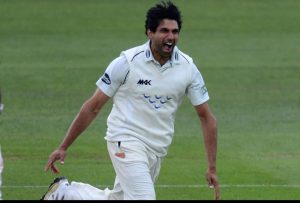
Amjad Khan: The county cricket experience was, to put it mildly, insane. I joined Kent in 2001, and in my first full season in 2002, I claimed 63 wickets, which felt like vindication. But before that, there was my first-class debut against Pakistan, and let me tell you, I got absolutely hammered. Pakistan’s openers ran riot, and they declared their first innings just six runs behind, leaving me to reflect on a brutal introduction to the professional game. You stand there thinking, “What have I gotten myself into?”
But here’s the thing that made it worthwhile—my first wicket was Saeed Anwar. Saeed bloody Anwar. One of the most elegant left-handers the game has ever seen, and I got him out. That softened the blow considerably. Then I spent the rest of the match and witnessing Wasim Akram, Mohammad Sami, and Shoaib Akhtar bowl. I was 20 years old, and the gap between where I was and where I needed to be felt astronomical. County cricket doesn’t ease you in gently—it throws you into the deep end and expects you to swim. Those early experiences were humbling, but they taught me more in a few months than years of comfortable cricket ever could.
I later moved to Sussex, where I spent several seasons before my county career ended in 2014. The grind of county cricket—the relentless schedule, the expectation, the constant need to prove yourself—is exhausting, but it’s also what shapes you as a cricketer. You either rise to it or you don’t.
Sandy: Amidst known names like James Anderson, Stuart Broad, Andrew Flintoff, Steve Harmison, and others, it isn’t an easy task to come up to the ranks and play for England. But, you did it! A few anecdotes on your journey into representing England at the highest level.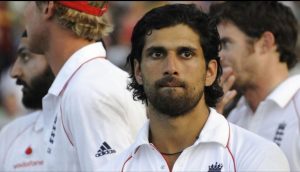
Amjad Khan: Making my England debut on March 6, 2009, against the West Indies in the Caribbean felt surreal. I played one Test match and one T20 International on that tour, and while my international career was brief—I never played for England again after that—it was an education in what elite cricket demands. I took one wicket in Test cricket, getting Ramnaresh Sarwan out LBW for 14, and picked up two in the T20I, dismissing Sarwan again along with Dwayne Bravo.
But the real value wasn’t in the statistics; it was in the company I kept. Jimmy Anderson, Freddy Flintoff, Steve Harmison—these are all tremendous guys, and I learned something vital from each of them. Jimmy was especially skillful, a master craftsman with the ball. Watching him set batsmen up, studying his control and his ability to exploit the smallest margins, was like taking a masterclass every time he bowled. Harmy and Freddy were the “dads” of the side, really. They took the younger lads under their wing, made sure we felt part of the group even when you were surrounded by all that talent and trying not to look hopelessly out of your depth. They were very protective, very encouraging, and very, very funny—the dressing room banter was relentless, which keeps you grounded when the pressure mounts.
It wasn’t easy breaking through into that company—I was granted British citizenship in December 2006, which made me eligible for selection, and earned my place through the England Academy. But having people like Anderson, Flintoff, and Harmison around made the journey considerably more enjoyable, even if my time in an England shirt was shorter than I’d hoped. The experience stays with you, though, and informs everything you do afterward, both on and off the field.
Sandy: Any memorable dressing room moments or piece of advice you’d received from your England players that you’d like to let us know.
Amjad Khan: I was very fortunate to play amongst and against some of the greatest cricketers the sport has ever produced. Sharing a changing room with Rahul Dravid at 19 was humbling in ways I can barely articulate—watching someone with his technique, his temperament, and his intellectual approach to the game was a masterclass in itself. Then there were Andrew Symonds, Muttiah Muralitharan, and Steve Waugh—bowlers and batsmen at the absolute pinnacle of their powers. When you’re standing in that dressing room, it’s not lost on you what you’re witnessing. Bowling at Lara and Sachin is something I’ll never forget—seeing the way they moved their feet, the completeness of their games, the hunger even in practice matches. Those are cherished memories that don’t fade.
But if I’m being honest about who influenced me most in terms of leadership and philosophy, it was my captains at Kent. Dave Fulton was a tremendous captain, exacting standards, tactically very sharp. But Rob Key, who is now the Managing Director of England Cricket, was unique. I believe deeply in his vision for English cricket—the way he thinks about the game, his approach to player development, and his ability to bring the best out of people. He shaped my thinking as a young cricketer.
The dressing room banter was relentless and, in many ways, kept you grounded. We for instance had a “chocolate club” at Kent consisting of Rob, Azhar Mahmood, Mark Ntini, and myself. The idea was that we’d pool our chocolate supplies and share them—until I became the persistent culprit nicking everyone’s chocolate. Eventually, I was rather embarrassingly voted out of the club. It sounds trivial, but those moments of levity in a pressure environment are vital. They remind you that despite the intensity of professional cricket, you’re still human, still capable of being ridiculous. There are many such memories scattered across my career that feel very special, and I feel profoundly blessed to have had them.
Sandy: You still continue playing cricket and mentor younger cricketers. What’s the difference you see in the current breed of upcoming cricketers with the ones from your early days?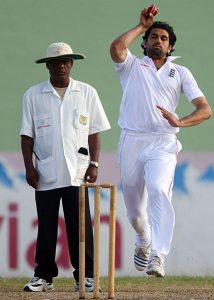
Amjad Khan: The current generation of cricketers are technically more sophisticated than we were at their age, without question. They have video analysis, biomechanical coaching, strength and conditioning programs that are light years ahead of what existed when I was coming through. A 17 year-old now knows more about their bowling action, their weaknesses, and their potential pathways than I did at 25.
But I think what’s changed most is the appetite for specialization and data. When I was playing, you learned through osmosis and repetition—you bowled and figured it out on the fly. Now, every delivery is analyzed, every weakness catalogued. That’s both brilliant and, in some ways, troubling. The younger lads are mentally more fragile in certain respects because there’s an algorithm attached to everything they do. The margin for error feels narrower.
What they’re missing, I think, is the romance of it. There’s less room for experimentation, for bowling an odd ball just to see what happens, for taking a risk because the conditions suit it. Everything is optimized, and while optimization gets results, it can also strangle creativity. The best cricketers I’ve known had an instinctive element to their play—they felt the game as much as they analyzed it.
Mentoring the younger players, I try to emphasize that. Yes, use the data, understand your metrics, know your plans. But also trust your instincts, bowl the ball that feels right even if the algorithm suggests otherwise. The game is still played by humans, and humans have intuition. That intuition, refined by experience, is as valuable as any statistic.
Sandy: Apart from cricket, you are in Law. Can you let the readers know a little bit about this other side of yours?
Amjad Khan: My legal career has become increasingly important to me, and it’s brought a different kind of fulfillment than cricket. I hold a Master of Laws degree and work as an assistant attorney at Aumento Law Firm in Denmark. My practice focuses on itigation. It’s demanding work that requires the same precision and attention to detail as cricket, though obviously in a wholly different arena.
My master’s thesis focused on pre contractual duties in mergers and acquisitions—a fascinating area where the tension between commercial freedom and good faith obligations creates genuinely interesting legal problems.
But the work I’m most proud of cricketing wise is pro-bono representation I’ve undertaken, particularly my involvement in the Essex County Cricket Club racism case.
Essex acknowledged responsibility, apologized, and committed to genuine change—which is what you hope for in these situations.
It was overall good to give back to cricket.
Quick Shot Round
– Your biggest regret: Not playing more Test cricket for England. I had one opportunity, and while I’m grateful for it, I wish I’d been given more chances to prove myself at that level.
– Your close pal from the cricket fraternity: Rob Key. Our bond went beyond cricket—he was mentor, captain, and genuine friend. Still is.
– Your favourite ball to bowl: The outswinger on a length. There’s something pure about it when it’s working—that moment of doubt in the batsman’s mind is everything.
– If not a cricketer, you would have been a: Lawyer—which, fortunately, I am anyway. I’ve always been drawn to the law; cricket just happened first.
– The toughest batsman you’d bowled to: Marcus Trescothick. Brutal.
– Most funniest cricketer in the dressing room: Murali – without any doubt.
– Given a chance to barter your career for a day with one other cricketer, with whom would you do and why?: Imran Khan. Not just because he inspired me to play cricket, but because I’d want to understand how he managed to be simultaneously a great bowler, a captain, and a leader who transcended sport. That’s a rare combination, and I’d want an afternoon to understand the architecture of that life.
Sandy: Any piece of advice you’d like to give to the upcoming cricketers?
Amjad Khan: Go max. And don’t look down. That’s it, really. When you’re a young cricketer coming through, there will be moments—plenty of them—where you’ll be tempted to limit your own ambitions, to play it safe, to not fully commit because failure stings. You’ll look at the names ahead of you in the queue, or the challenges in front of you, or the doubts in your own head, and you’ll shrink a little.
Don’t.
Go at it with everything you have. Bowl your fastest, play your boldest, think your biggest. The worst thing that happens is you fail—and you’ll fail anyway sometimes, that’s part of the deal. But you’ll fail having given it absolutely everything, and there’s real dignity in that. And sometimes, when you do that consistently, you’ll surprise yourself.
The “don’t look down” part is crucial. Once you start second-guessing, once you start worrying about what others think, once you start playing not to lose instead of playing to win, it’s over. The moment you look down at the tightrope you’re walking on, you lose your balance. Look ahead, look at the target, look at what you want to achieve. The physics of the moment doesn’t change, but your mental approach does. And in cricket, as in most things, the mental approach is everything.
Editor’s note: Amjad Khan’s journey is a rare blend of grit, intellect, and dual passion—a story that transcends boundaries, both literal and professional. From the quiet cricket grounds of Copenhagen to the intensity of English county cricket and the precision of courtroom debates, his path reflects unwavering dedication to excellence. His insights remind us that true mastery lies not only in skill but in humility and perseverance—qualities that continue to define him beyond the pitch.
What an electrifying chat with Amjad Khan—pure fire on and off the pitch! Wishing him whirlwind success in the seasons ahead, and can’t wait to team up again for our next boundary-smashing project.
Interview by Sandeep Rao (Sandy)
Follow on Instagram:
Sandy @blabwithsandy
Amjad Khan @amjadkn